
There’s a quiet shift taking place in Milan.
As Spring/Summer 2026 menswear collections unfolded beneath the June sun, three designers—Miguel Vieira, David Catalán, and Simon Cracker—offered something unusual: not spectacle, but introspection. Their visions differed in silhouette and source, yet each challenged the masculine uniform not through reinvention, but reorientation, representing fashion as a philosophy, stitched from memory, restraint, and quiet rebellion.

Miguel Vieira led us into darkness, not the harsh kind, but one softened by elegance. His collection, “A Night in the Garden,” cloaked every look in black, punctuated only by silver glints and the rare, moonlit white. On the runway, tailoring was sculptural, almost meditative. Silk jackets, mesh tops, and precise trousers bore floral embellishments with camellias and calla lilies rendered in beads and leather. These weren’t florals for adornment’s sake; they felt like relics that grew in shadow. The Japanese actor and singer, Raul, moved like a figure from a monochrome dream—silent, potent, unknowable.
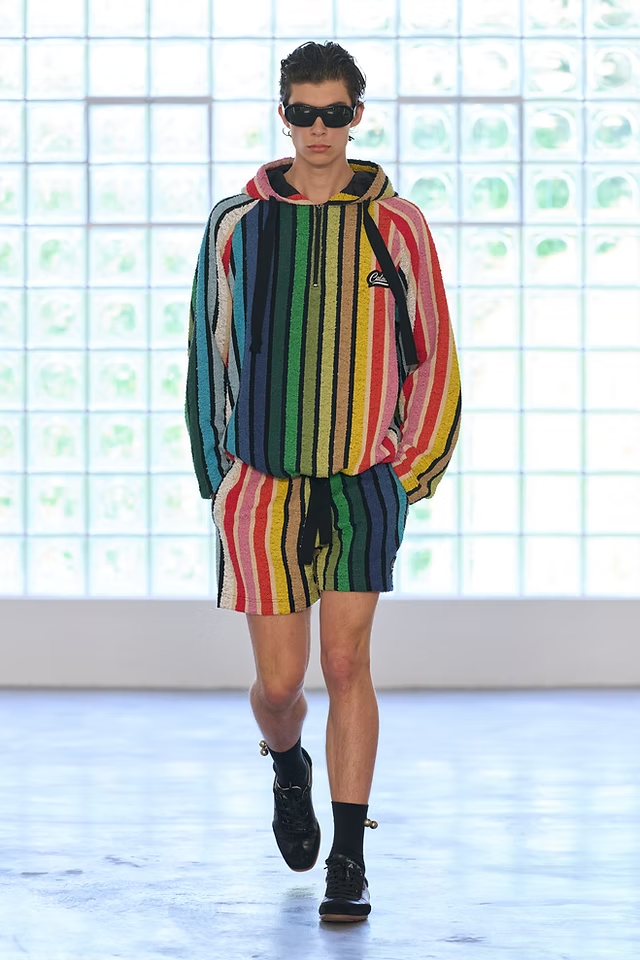
Where Vieira gave us nocturne, David Catalán turned to earth. His collection, titled “PROBLEMS,” proposed an argument: that identity is layered, and style can be political without being literal. Drawing from Portuguese rural motifs such as manta textiles, shepherd bells, and folk structures, Catalán translated them into the city’s grammar, presenting cropped jackets with utility pockets, layered shirts in mineral blues and clay reds, and tech-fabric trousers cut for movement. The result was neither nostalgic nor futuristic, but somewhere in between: a tension held in the folds of the clothes. He wasn’t trying to resolve the rural/urban divide, but he was asking us to wear it.

Simon Cracker, as always, came to undo with his SS26 collection, riffing on repetition with purpose. Known for his upcycling philosophy, Cracker’s garments began from near-uniformity with boxy tees, shorts, and jackets, later unraveling into something singular. A T-shirt fused with another at the seam. A jacket restructured so it leaned, slightly, like a tired gesture. Even his palette—grey, ecru, white, black—refused drama, so the eye had to seek detail. There were no runway tricks, no crescendos; just garments that asked to be studied. Crocs appeared too, “Crackerised” with charms, tags, and attitude. The whole collection whispered what fast fashion screams: that nothing new is truly new unless it knows what it’s made of.
Together, these three voices did not align by design, yet something held them in orbit: a shared belief that menswear no longer needs to shout. Vieira’s brooding romance, Catalán’s functional memory, and Cracker’s precise undoing pointed toward a masculinity that is thoughtful, fragmented, and emotionally literate.
In an industry still addicted to speed and hype, these collections dared to offer patience, asking us not to look harder, but to look longer. In doing so, they reminded us that style, at its most enduring, is less about what we wear and more about what we remember.
Leave a Reply